Frequently Asked Questions
The most-asked questions about periodic table & elements.
What exactly is the periodic table?
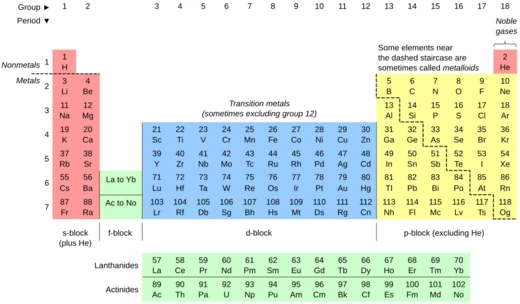
The periodic table is a chart that arranges all known chemical elements in order of increasing atomic number, organized into rows called periods and columns called groups so that elements with similar chemical properties line up vertically. It serves as the central reference tool in chemistry.
Who is the key figure behind the periodic table?
Dmitri Mendeleev, a Russian chemist, is widely credited with publishing the first broadly recognized periodic table in 1869, arranging elements by atomic mass and leaving gaps for elements he predicted would later be discovered. His layout became the foundation for the version used today.
How many elements are on the periodic table?
There are currently 118 confirmed elements, ranging from hydrogen (atomic number 1) to oganesson (atomic number 118). Elements 93 through 118 were all synthesized in laboratories rather than found in nature.
How is the periodic table organized?
Elements are sorted left to right by atomic number and grouped into 18 vertical columns (groups) and 7 horizontal rows (periods), with a separate row for the lanthanides and actinides. This arrangement reflects electron shell structure and reveals recurring patterns in reactivity, size, and bonding behavior.
What do the element symbols mean?
Each one- or two-letter symbol is derived from the element's English, Latin, Greek, or German name, such as Fe for iron (from Latin ferrum) or W for tungsten (from wolfram). The symbols are internationally standardized by IUPAC.
Where should a beginner start learning about elements?
A good entry point is to first understand the layout—groups, periods, and the metal/nonmetal divide—then focus on the first 20 elements, which cover the most common building blocks of everyday matter. After that, exploring the major families like alkali metals, halogens, and noble gases makes the rest of the table feel much less intimidating.
What are the main element families or categories?
The table is divided into alkali metals, alkaline earth metals, transition metals, post-transition metals, metalloids, nonmetals, halogens, and noble gases, plus the f-block lanthanides and actinides. Each family shares a characteristic set of chemical and physical traits that repeat down the column.
What is the most abundant element in the universe?
Hydrogen makes up roughly 75 percent of all normal matter by mass, forming the core fuel of stars and the simplest atom with a single proton and electron. On Earth, however, oxygen is the most abundant element by mass in the crust.
What is the newest element added to the table?
Oganesson (element 118) was officially named in 2016, completing the seventh period. It was synthesized in a Russian laboratory by bombarding californium with calcium ions, and only a handful of atoms have ever been observed.
Why does the periodic table feel like a story or a fan favorite?
Its elegant grid format, the drama of predicting missing elements, and the sheer variety of bizarre properties—from glowing astatine to inert xenon—give it a narrative arc that resonates beyond pure chemistry. Many fans enjoy collecting element-themed memorabilia, trivia about discovery stories, and following the ongoing quest to synthesize superheavy elements.