Flerovium
Synthetic superheavy element near the island of stability.

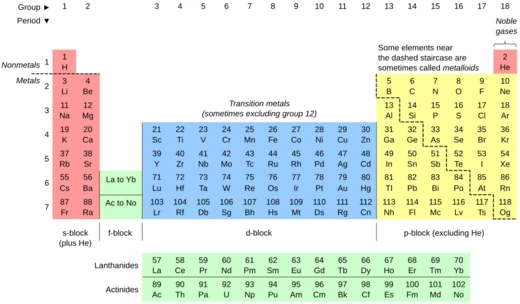
It is a transactinide in the p-block of the periodic table, the heaviest known member of the carbon group, and is predicted to be near the center of the theorized island of stability.
- symbol
- Fl
- discovery_location
- Flerov Laboratory of Nuclear Reactions, Joint Institute for Nuclear Research, Dubna, Russia
- group
- carbon group (group 14)
- period
- 7
- block
- p-block
Lore & Background
One atom was detected, alpha decaying with a lifetime of 30.4 seconds, and was assigned to 289Fl. More recent results show its reaction with gold is similar to that of copernicium, suggesting it is very volatile and may even be gaseous at standard temperature and pressure, though it also shows some metallic properties consistent with being the heavier homologue of lead. Very little is known about flerovium, as it can only be produced one atom at a time, and all known isotopes are short-lived.
Reader's Guide
Flerovium is significant as the heaviest known member of the carbon group and a key element in the search for the island of stability, a theorized region of relatively long-lived superheavy nuclei. Although the most stable known isotope, 289Fl, has a half-life of only about 2.1 seconds, the unconfirmed 290Fl may have a half-life of 19 seconds, and heavier isotopes like 298Fl are expected to have even longer half-lives. The element's volatile behavior, similar to copernicium and possibly gaseous at standard conditions, challenges expectations for a group 14 element and provides insights into relativistic effects in superheavy chemistry. Its legacy includes validating decades of theoretical work and opening avenues for exploring the farthest reaches of the periodic table.
Did You Know?
- Flerovium is named after the Flerov Laboratory of Nuclear Reactions, which honors Russian physicist Georgy Flyorov.
- The most stable known isotope, 289Fl, has a half-life of about 2.1 seconds, but the unconfirmed 290Fl may have a half-life of 19 seconds.
- Flerovium is predicted to be near the center of the theorized island of stability, and the possibly magic isotope 298Fl may have even longer half-lives.
Frequently Asked Questions
Why is Flerovium considered important to nuclear physics?
Flerovium is predicted to lie near the center of the theorized island of stability, a region where superheavy nuclei could be surprisingly long-lived compared to their neighbors. That makes it a key data point for testing models of nuclear binding at extreme mass numbers.
Can Flerovium be found in nature?
No. Flerovium is entirely synthetic and extremely radioactive, so it does not occur naturally anywhere on Earth. It exists only in vanishingly small, short-lived quantities produced inside particle accelerators.
What is Flerovium's 'role' in the carbon group?
As the heaviest known element in group 14, Flerovium represents the outer edge of the carbon family, sitting far below lead and copernicium. Its predicted chemical behavior—possibly showing more noble-gas-like or metallic traits due to relativistic effects—makes it a fascinating outlier among its lighter groupmates.
More in Periodic Table & Elements 1-21
Spotted an error? Know more?
This is a living reference — every entry is fact-audited, and reader corrections feed straight into our audit queue. Suggest an edit · See this site's audit record