Group 11 element
Group of metals including copper, silver, gold, and roentgenium.

KKPCW · CC BY-SA 4.0
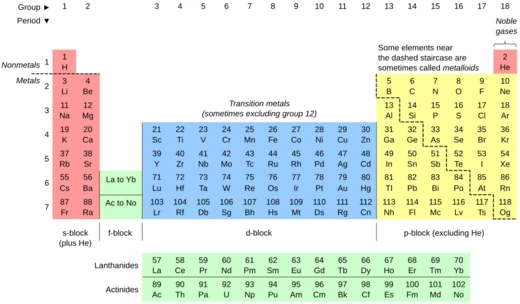
Group 11, by modern IUPAC numbering, is a group of chemical elements in the periodic table consisting of copper (Cu), silver (Ag), gold (Au), and roentgenium (Rg). The first three members are known as the coinage metals due to their historical use in minting coins, and they were likely the first three elements discovered, occurring naturally in elemental form.
- members
- Copper, silver, gold, roentgenium
- common_name
- Coinage metals (for first three)
- key_property
- Excellent electrical and thermal conductivity
- occurrence
- Native form and ores (copper, silver, gold); synthetic (roentgenium)
Lore & Background
All three stable elements of Group 11 have been known since prehistoric times, as they occur in metallic form in nature and require no extraction metallurgy. Gold artifacts appear in Egypt at the end of the fifth millennium BC and in Lower Mesopotamia during the early 4th millennium BC.
Reader's Guide
Group 11 elements are relatively inert, corrosion-resistant metals with low electrical resistivity, making them essential for wiring and electrical applications. Copper is the cheapest and most widely used for wiring, while gold is used for bond wires in integrated circuits, and silver appears in special applications. Silver is the most conductive metal by volume, the most thermally conductive, and the most light-reflecting. These metals have been historically used for coinage, though inflation has led most modern coins to be made of base metals. Copper remains common in coins, either as copper clad or in cupronickel alloy. Biologically, copper is essential for life but toxic in excess, while elemental gold and silver have no known toxic effects, though their salts can be harmful. Roentgenium is radioactive and likely extremely harmful. The group's combination of conductivity, corrosion resistance, and historical monetary value has made them central to technology, medicine, and economics.
Did You Know?
- Copper, silver, and gold all occur naturally in elemental form.
- Silver is the most thermally conductive element and the most light-reflecting element.
The Coinage Metals: A Group Forged in History
Group 11 carries the informal title "coinage metals," a name that speaks to the practical heritage of copper, silver, and gold as materials shaped into currency across civilizations. The group's identity as a family rests on shared chemical behavior rooted in their outermost electron shells, which confer a common core charge and similar orbital arrangements. However, the membership question becomes thorny at the bottom of the column. Roentgenium (Rg) sits in group 11 and is expected to be chemically similar to gold, yet its extreme radioactivity and short half-life make it entirely unsuitable for the coinage that gives the family its name. Because of this, some authors exclude it from the coinage metal designation, while others include it purely on the basis of its column position. This tension between chemical expectation and practical reality makes Group 11 a fascinating case where a group's traditional name collides with the realities of superheavy element chemistry.
Electron Architecture: Why the Column Holds Together
The reason copper, silver, gold, and roentgenium cluster in the same vertical column is fundamentally electronic. In the periodic table, elements within a group share similar physical and chemical characteristics because their outermost electron shells occupy comparable orbital locations. This shared core charge means that the orbital position of the outermost electron dominates their chemical behavior, binding the group together despite vast differences in atomic mass. The modern 1-to-18 numbering scheme, endorsed by IUPAC since 1988, encodes this logic directly: each group number reflects the count of s, p, and d electrons beyond those present in the preceding noble gas. For Group 11, this electron bookkeeping places these elements in a distinct chemical niche. The 14 f-block columns that sit between groups 2 and 3 remain unnumbered, a structural quirk that keeps the 18-group framework intact while acknowledging the inner transition metals as a separate architectural layer in the table's 32-column layout.
The Numbering Wars: From A/B Suffixes to a Unified 1–18
Before the chemistry community settled on a single numbering convention, Group 11 was known by different labels depending on which side of the Atlantic you stood. The old IUPAC system, popular in Europe, assigned the letter B to the right-hand portion of the table, while the CAS system, dominant in the United States, reserved B for transition elements. Both systems used the same underlying numerals—reflecting approximately the highest oxidation number of the elements in that group—but the A and B suffixes pointed to different things. This confusion, where identical names carried contradictory meanings across continents, motivated IUPAC to propose a clean left-to-right numbering from 1 to 18. Under this unified scheme, Group 11 simply occupies its eleventh column, free from the A/B ambiguity that had muddled its identity for decades.
Beyond the Column: Noble Metals and the Iron Group Problem
While the periodic table defines groups strictly as vertical columns, chemistry also recognizes sets of elements that share properties without occupying a single column. Group 11's members naturally align with broader informal families such as noble metals and precious metals, categories that cut across multiple columns based on shared chemical behavior rather than electron bookkeeping. The "iron group" illustrates how easily these non-columnwise designations can create confusion: in one context it refers to group 8, in chemistry it may mean iron, cobalt, and nickel, and in astrophysics or nuclear physics it can expand to include chromium and manganese as well. This fluidity contrasts sharply with the rigid 1-to-18 column system. Meanwhile, the correct positioning of inner transition metals has been known since 1948 and was endorsed by IUPAC in both 1988 and 2021, yet textbook variation persists. Group 11, by contrast, enjoys a stable and unambiguous column identity, even as its members participate in these broader, less formal chemical families.
Gallery





Frequently Asked Questions
What is a Group 11 element?
Group 11 is a vertical column on the periodic table that holds four metallic elements: copper, silver, gold, and roentgenium. They are transition metals celebrated for their outstanding electrical and thermal conductivity.
Why are copper, silver, and gold called the coinage metals?
They earned that common name because human civilizations have relied on them to mint durable currency for millennia. Their natural availability in elemental form and strong resistance to corrosion made them practical choices for long-lasting coins.
What key property defines Group 11 elements?
Every member shares exceptional electrical and thermal conductivity, which is why copper and silver dominate wiring and heat-exchange applications. This trait traces back to each element's single loosely held valence electron.
More in Periodic Table & Elements 1-21
Spotted an error? Know more?
This is a living reference — every entry is fact-audited, and reader corrections feed straight into our audit queue. Suggest an edit · See this site's audit record