Group 12 element
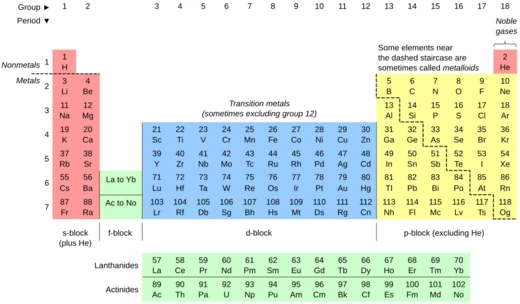
Group 12 elements: soft metals with full d-shells.

U.S. Navy · Public domain
Group 12, by modern IUPAC numbering, is a group of chemical elements in the periodic table. It includes zinc (Zn), cadmium (Cd), mercury (Hg), and copernicium (Cn). Formerly this group was named IIB. The three naturally occurring group 12 elements—zinc, cadmium, and mercury—are widely used in electric and electronic applications, as well as in various alloys. Zinc is important in biochemistry, while cadmium and mercury are highly toxic. Copernicium does not occur in nature and must be synthesized in the laboratory.
- elements
- Zinc, cadmium, mercury, copernicium
- former_name
- Group IIB
- natural_occurrence
- Zinc, cadmium, mercury occur naturally; copernicium is synthetic
- common_properties
- Soft, diamagnetic, divalent metals; lowest melting points among transition metals
- notable_characteristic
- Mercury is the only metal liquid at room temperature; copernicium's phase under standard conditions is unknown
Lore & Background
The group 12 elements are all soft, diamagnetic, divalent metals with the lowest melting points among all transition metals. Zinc is bluish-white and lustrous, though most commercial grades have a dull finish; it is also called spelter in nonscientific contexts. Cadmium is soft, malleable, ductile, and bluish-white. Mercury is a liquid, heavy, silvery-white metal, the only common liquid metal at ordinary temperatures, and a poor conductor of heat but a fair conductor of electricity. Copernicium's properties are based on relativistic density-functional theory simulations. Cadmium is similar to zinc but forms complex compounds and is resistant to corrosion, used as a protective layer on other metals. Mercury's exceptionally low melting temperature is explained by its unique electronic configuration, where electrons fill all available subshells up to 6s, resisting electron removal and forming weak bonds. The stability of the 6s shell is due to the filled 4f shell and lanthanide contraction. Zinc, cadmium, and mercury form a large range of alloys. Brass is an alloy of zinc and copper. Cadmium is used in solder and bearing alloys due to low friction and fatigue resistance. Mercury dissolves other metals to form amalgams, with iron being a notable exception, so iron flasks have been used to trade mercury. Mercury readily combines with aluminium to form an amalgam that corrodes aluminium, so mercury is not allowed aboard aircraft.
Reader's Guide
Group 12 elements occupy a unique position in the periodic table. Due to their complete d-shell, they are sometimes excluded from the transition metals. All three naturally occurring members are metals with relatively low melting and boiling points, indicating weak metallic bonding. Zinc and cadmium are electropositive and good reducing agents, while mercury is not. The elements typically exhibit a +2 oxidation state with a stable d10 configuration, though mercury can also form +1 compounds such as Hg2²⁺. The chemistry of copernicium is not well established. These elements have significant practical applications. Zinc is vital in biochemistry and used in alloys like brass. Cadmium's corrosion resistance makes it valuable for protective coatings and low-melting alloys. Mercury's liquid state and ability to form amalgams have made it useful in various industrial and chemical processes, though its toxicity limits use. The group illustrates periodic trends affected by the lanthanide contraction, with cadmium and mercury having similar metallic radii unlike the smooth increase seen in group 2. The classification of group 12 elements remains debated: some consider them main-group elements due to ns² valence electrons, while IUPAC's definition of transition metals (based on incomplete d sub-shell) would classify only mercury as a transition metal, given its disputed compound mercury(IV) fluoride.
Did You Know?
- Mercury is the only metal that is known to be a liquid at room temperature.
- Zinc is also referred to in nonscientific contexts as spelter.
- The alloy ZrZn2 exhibits ferromagnetism below 35 K, though neither zinc nor zirconium are ferromagnetic.
- Mercury is not allowed aboard an aircraft because it forms an amalgam with exposed aluminium parts, which corrodes the aluminium.
The Chemical Logic Behind Group Membership
Groups in the periodic table are defined as vertical columns of elements, and there are exactly eighteen such numbered columns in the standard layout. What unites the members of any given group is a shared configuration in their outermost electron shells, which gives them an identical core charge. Because the orbital location of that outermost electron overwhelmingly governs an element's reactivity and bonding behavior, elements stacked in the same column tend to display remarkably similar physical and chemical traits. Beyond the eighteen numbered columns, the periodic table also contains fourteen unnumbered f-block columns tucked between groups 2 and 3, bringing the total to thirty-two vertical divisions. This structural arrangement means that the periodic table is not merely a catalog of known substances but a framework organized around electron architecture, with each column representing a distinct valence-electron pattern that recurs down the table.
From Confusion to Consensus: The Numbering Revolution
For much of the twentieth century, chemists in different regions relied on incompatible group-numbering schemes. The Chemical Abstracts Service system, dominant in the United States, and the earlier IUPAC convention, favored in Europe, both employed Arabic or Roman numerals paired with the letters A and B. Crucially, the two systems assigned those letters to opposite categories: the old IUPAC scheme placed A on the left side of the table and B on the right, whereas CAS reserved A for main-group elements and B for transition metals. This meant the same label could point to entirely different columns depending on which convention a reader followed.
Beyond Numbers: Trivial Names and the Iron-Group Puzzle
While the modern system labels columns one through eighteen, chemists have long preferred evocative trivial names that capture a group's character. Group 16, for instance, is simultaneously called the oxygen group and the chalcogens; group 13 members are triels, group 14 the tetrels, and group 15 the pentel, each derived from Greek numerical roots. The halogens of group 17 carry their own well-known label. More contentious is the so-called iron group. In most chemistry contexts it denotes group 8, yet it can also refer to the trio of iron, cobalt, and nickel, or to a broader set that adds chromium and manganese. In astrophysics and nuclear physics, that expanded five-element definition is the norm. Group 11 is known as the coinage metals because its members—copper, silver, and gold—have historically been minted into currency. Roentgenium, the heaviest group-11 element, is expected to resemble gold chemically, but its extreme radioactivity and fleeting half-life make it unsuitable for any practical coinage, leading some authors to exclude it from the family.
Borderline Cases and Groups That Defy the Column
Not every grouping in chemistry fits neatly into a single vertical column. The periodic table's first two positions—hydrogen and helium—remain subjects of ongoing debate, with some chemists questioning whether these elements truly belong in groups 1 and 2 respectively. Similarly, the placement of the inner transition metals (the lanthanides and actinides) has generated persistent variation in textbooks, even though the correct positioning was established as early as 1948 and was reaffirmed by IUPAC in both 1988 and 2021. Outside the columnar framework entirely, several sets of elements are colloquially called groups despite spanning multiple columns. Noble metals, precious metals, refractory metals, and the coinage metals all belong to this category of non-columnwise groupings. These labels reflect shared practical or economic properties—such as resistance to corrosion or high melting points—rather than a single valence-electron configuration, reminding us that the periodic table's columnar logic, while powerful, does not exhaust every meaningful way to organize the elements.
Gallery





Frequently Asked Questions
What elements are in Group 12?
Group 12 consists of zinc, cadmium, mercury, and copernicium. Under the older naming convention, this family was known as Group IIB.
What makes Group 12 elements stand out among the transition metals?
They are soft, diamagnetic, divalent metals with completely filled d-shells and the lowest melting points of any transition-metal group. This combination of properties sets them apart from their neighbors.
Why is mercury so famous in Group 12?
Mercury is the only metal in the group—and indeed the only metal overall—that exists as a liquid at room temperature. That unusual phase behavior makes it instantly recognizable to anyone who has handled a thermometer or barometer.
Which Group 12 elements can you find in nature?
Zinc, cadmium, and mercury all occur naturally and see widespread use in electronics, alloys, and (for zinc) biochemistry. Copernicium, by contrast, does not exist in the natural world and must be synthesized in a laboratory.
What is the phase of copernicium under standard conditions?
Copernicium's physical state at standard temperature and pressure remains unknown. Because it is purely synthetic and produced only in trace, short-lived quantities, its bulk properties have never been directly measured.
More in Periodic Table & Elements 1-21
Spotted an error? Know more?
This is a living reference — every entry is fact-audited, and reader corrections feed straight into our audit queue. Suggest an edit · See this site's audit record