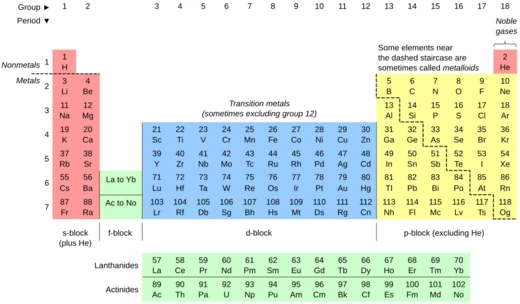
Group 10 element
Group of d-block transition metals including nickel, palladium, platinum, and darmstadtium.

KKPCW · CC BY-SA 4.0
Group 10, numbered by current IUPAC style, is the group of chemical elements in the periodic table that consists of nickel (Ni), palladium (Pd), platinum (Pt), and darmstadtium (Ds). All are d-block transition metals. Only nickel, palladium, and platinum have had their properties experimentally confirmed; darmstadtium has not been isolated in pure form and its properties have not been conclusively observed.
- group_number
- 10 (IUPAC)
- elements
- Nickel, Palladium, Platinum, Darmstadtium
- common_oxidation_states
- +1 to +4; +2 common for Ni and Pd; +2 and +4 common for Pt
- physical_appearance
- Silvery-white, hard, lustrous, ductile (Ni, Pd, Pt)
- key_characteristic
- Resistant to tarnish at STP, refractory, high melting and boiling points
- notable_exception
- Pd and Pt ground state electronic configurations are exceptions to Madelung's rule
Lore & Background
Nickel was not formally named until A. F. J. B.
Reader's Guide
Group 10 elements are significant for their diverse applications and historical roles. Nickel, palladium, and platinum are used in jewelry, electroplating, catalysts, metal alloys, electrical components, and superconductors. Platinum complexes are commonly used in chemotherapy as anticancer drugs, while palladium complexes show marginal antitumor activity. The group includes darmstadtium, a synthetic radioactive element with short half-lives not found in nature. Nickel occurs naturally in ores and is Earth's 22nd most abundant element, with Indonesia holding the world's largest reserve and being its largest producer. The discovery histories of these elements involve early ancient use, controversies over isolation and naming, and the development of powder metallurgy techniques for platinum. Their resistance to tarnish, high melting points, and ductility make them valuable in industrial and decorative contexts.
Did You Know?
- The ground state electronic configurations of palladium and platinum are exceptions to Madelung's rule.
- Platinum has been observed in oxidation states from -3 to +6, and theory suggests a +10 state may be possible.
- Nickel was used in antiquity from meteoric iron, as suggested by the Sumerian name for iron 'an-bar' (fire from heaven).
- Darmstadtium has not been isolated in pure form, and its properties have not been conclusively observed.
The Electronic Architecture Behind Group 10's Character
In the periodic table, elements are organized into vertical columns called groups, and the shared chemical and physical traits within any given group trace back to a single structural feature: the configuration of outermost electron shells. Because most chemical behavior is governed by where the outermost electron sits in its orbital, elements stacked in the same column—sharing the same core charge—exhibit remarkably similar reactivity. Group 10, which sits among the transition metals, benefits from this principle just as the alkali metals or halogens do. The modern framework recognizes eighteen numbered groups in total, with fourteen additional f-block columns tucked between groups 2 and 3 left unnumbered, bringing the full table to thirty-two columns. This columnar architecture is what allows chemists to predict how a Group 10 member will bond, oxidize, or interact with ligands simply by knowing its position, without needing to memorize each element's behavior in isolation. The grouping principle is, in essence, the periodic table's most powerful predictive tool.
From Confusion to Clarity: The Numbering Overhaul
Before 1988, chemists in different parts of the world could look at the same periodic table and assign entirely different numbers to the same column. The Chemical Abstract Service system, dominant in the United States, and the older IUPAC scheme, favored in Europe, both relied on Arabic or Roman numerals paired with A and B suffixes, yet they applied those letters in contradictory ways. In the old IUPAC approach, A marked the left side of the table and B the right; in the CAS approach, A denoted main-group elements and B transition elements. This meant a label like "group VIIB" could point to different columns depending on which convention a reader assumed. The new system counts s, p, and d electrons beyond those of the preceding noble gas, giving every column a unique, unambiguous identity.
Trivial Names and the Iron Group Problem
Beyond their numerical labels, groups often carry colorful trivial names drawn from their most famous member or from Greek roots. Group 16, for instance, is simultaneously called the oxygen group and the chalcogens, while group 13 members are sometimes triels, group 14 the tetrels, and group 15 the pentel, each derived from Greek numerals. A persistent source of confusion, however, is the phrase "iron group." In most chemistry contexts it points to group 8, yet in other settings it refers to the trio of iron, cobalt, and nickel, or to yet another cluster of elements sharing similar chemical behavior. In astrophysics and nuclear physics, the term broadens further to include chromium and manganese alongside iron, cobalt, and nickel. This ambiguity highlights how group identity can shift depending on the discipline doing the talking. Historically, even the numbering was messier, with Roman numerals from I to VIII combined with A and B suffixes creating multiple incompatible labeling schemes before the current system settled the debate.
Dissent, Exceptions, and the Bigger Table
Even with the 1–18 system widely adopted, the chemistry community has not reached perfect consensus on every detail. The placement of hydrogen and helium remains a point of genuine disagreement, with some arguing they do not fit neatly into groups 1 and 2 despite their conventional positions. Similarly, the positioning of inner transition metals has been debated in textbooks, although the correct arrangement has been understood since 1948 and was formally endorsed by IUPAC both in 1988, alongside the new numbering, and again in 2021. The periodic table also contains sets of elements called "groups" that do not correspond to a single column at all—noble metals, coinage metals, precious metals, and refractory metals are examples of these non-columnwise groupings. The coinage metals, for instance, sit in group 11, and while roentgenium is expected to resemble gold chemically, its extreme radioactivity and short half-life mean it can never actually be minted into currency, leading some authors to exclude it from the family.
Gallery




Frequently Asked Questions
Who is Group 10 element?
Group 10 is a vertical column of four d-block transition metals on the periodic table, comprising nickel, palladium, platinum, and darmstadtium. The number 10 follows the current IUPAC convention for labeling groups.
What are Group 10 element's powers/role?
These metals are silvery-white, hard, lustrous, and ductile, with notably high melting and boiling points that classify them as refractory. A defining shared trait is their resistance to tarnishing under standard temperature and pressure conditions.
How does Group 10 element's story end?
Darmstadtium, the heaviest member, has never been isolated in bulk pure form, so its chemical behavior remains experimentally unconfirmed. This leaves it as the group's unresolved final chapter, while nickel, palladium, and platinum are thoroughly characterized.
Why is Group 10 element important?
Members display oxidation states spanning +1 through +4, with +2 especially common for nickel and palladium and both +2 and +4 for platinum. This flexible redox chemistry makes the group highly valuable in catalysis and industrial applications.
What makes Group 10 element's backstory unusual?
Palladium and platinum both break Madelung's rule in their ground-state electron configurations, deviating from the expected orbital-filling order. This anomaly is a well-known curiosity among chemistry enthusiasts and distinguishes them from most other transition metals.
More in Periodic Table & Elements 1-21
Spotted an error? Know more?
This is a living reference — every entry is fact-audited, and reader corrections feed straight into our audit queue. Suggest an edit · See this site's audit record